Raw or cooked weight? A simple way to avoid mismatched food entries
Why cooking changes the weight on your plate, how to match a food diary entry, and a worked example without a universal conversion factor.
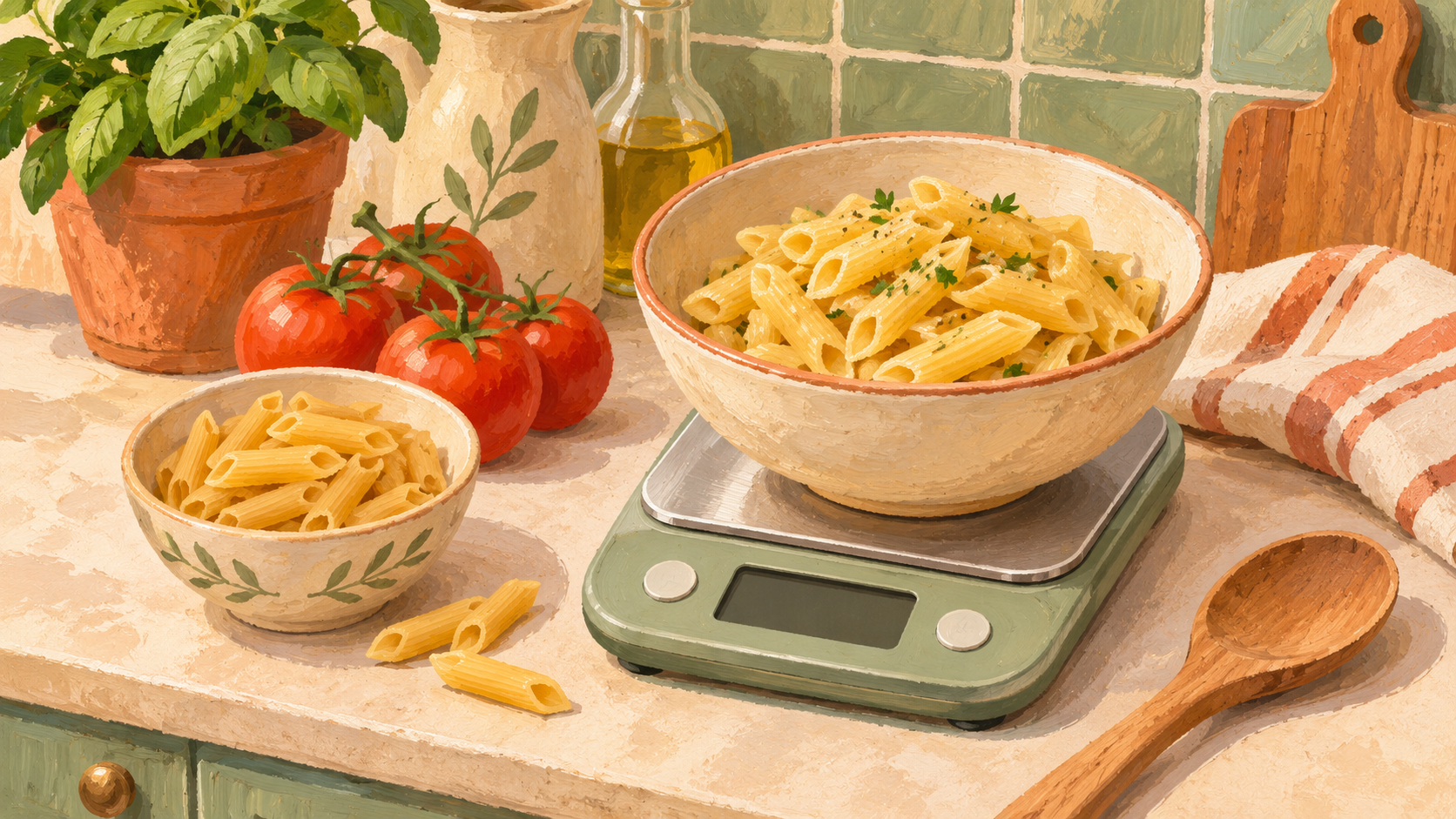
Match the food’s state before comparing the number
Established-evidence explainer. A weight measured after cooking should not automatically be entered against a raw-food listing. USDA cooking-yield research documents changes in food weight from water loss or absorption and fat loss or gain. The change depends on the food and preparation. There is no single raw-to-cooked multiplier that works for every meal. USDA research and methods.
The practical question is: does the entry describe what you measured? Check words such as raw, dry, cooked, drained or prepared before looking at the nutrient totals.
A worked example with clearly fictional numbers
Imagine a plain food labelled with 12 g protein per 100 g dry. You cook 240 g dry and the finished batch weighs 600 g. For this simplified example, assume only water changes and all the original protein remains in the batch:
- Dry batch: 2.4 × 12 = 28.8 g protein.
- A 150 g cooked portion is one-quarter of the 600 g batch.
- One-quarter of 28.8 g is 7.2 g protein.
Entering those 150 cooked grams as 150 dry grams would instead give 18 g—because it describes a different amount of the original food. These are invented teaching numbers, not a food database entry or a recommended portion.
Why the simple calculation has limits
Real cooking can involve discarded liquid, fat loss and added ingredients. USDA nutrient calculations account for yields and nutrient retention, not just a change in scale weight. Its meat and poultry tables describe specific cuts and cooking protocols; they are not exact predictions for your saucepan. Yield and retention background.
For an everyday diary, choosing an appropriate cooked entry may be more useful than applying an invented conversion. For a mixed meal, use an entry that reflects the ingredients and preparation as closely as practical. Do not count an ingredient separately if it is already included in the meal entry.
Check the label’s unit too
On US Nutrition Facts labels, nutrient amounts generally refer to the stated serving, and a package can contain several servings. The FDA also emphasizes that the listed serving is not a recommendation for how much you should eat. Other countries use different label formats, so read the actual unit. FDA label guide.
Before logging, make three checks: the food’s state, the unit, and whether additions are included. If information is missing, use a reasonable estimate and keep the uncertainty in mind. A precise-looking number is still an estimate.
Use the diary to reduce confusion
MacroTracker’s food search and barcode scanning can help locate an entry; compare it with the package and what you prepared. You do not need to turn every meal into a laboratory exercise. For ages 16–17, food records should support adequate nourishment, not rigid weighing or restriction. Our rice-storage guide covers the separate safety question after cooking.
Sources
AI-assisted article, checked against the linked sources. No clinical review is claimed. General education, not individual medical advice. Read our editorial standards and correction policy.