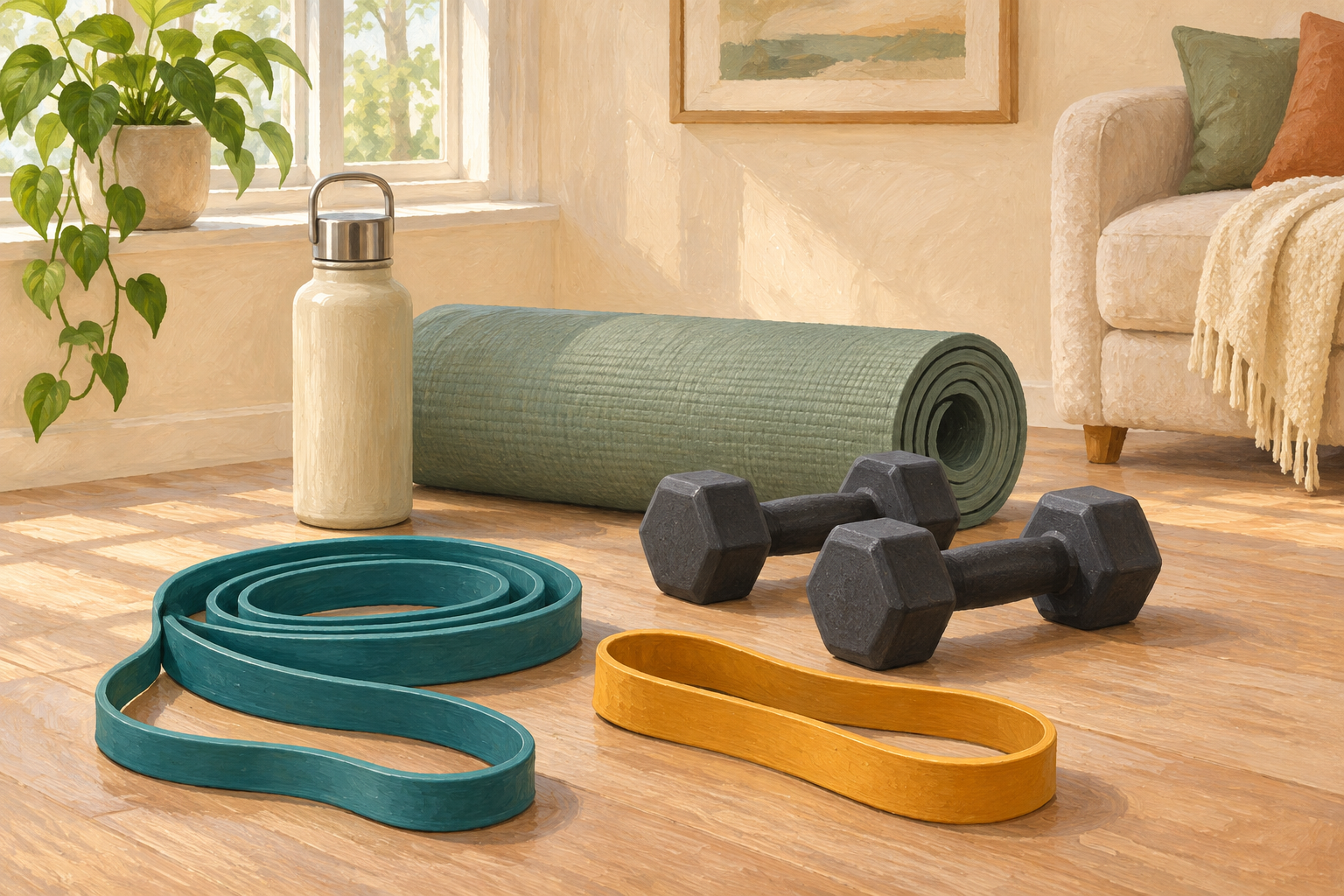
Bands or weights at home? Choose a setup you can progress
A corrected research review found no clear strength advantage for bands or conventional weights. Learn the limits and how to choose useful home equipment.
What the corrected review found
A 2019 review, corrected in 2020, combined seven studies involving 224 people and found no clear strength advantage for elastic resistance over conventional weights, or vice versa. The participants spanned adolescents through older adults, with varied health and training backgrounds. Original review and published correction.
The correction matters: it fixes the study count and swapped upper- and lower-limb labels, among other errors. This established-evidence explainer uses the corrected count. Failure to detect a difference is not proof that the methods are identical for every person or goal.
What the evidence leaves open
The review included few studies, varied protocols and inconsistent control of band resistance. It cannot establish identical muscle growth or elite lifting performance. CAPES scholarship support was disclosed, with no potential conflicts declared. Review limitations and funding.
The practical decision is not whether one piece of equipment wins universally. It is whether you can use your chosen setup consistently and make training appropriately more challenging as you improve.
Choose the exercises before the shopping basket
Write down what you want the equipment to let you do. Then check whether your space and the product's instructions support those movements. A compact band is convenient to store, but an exercise requiring an anchor still needs a suitable place to attach it. Dumbbells need storage and enough clear space to handle them.
If you already have equipment, try planning around it before buying a larger set. A qualified trainer can help select movements and demonstrate a setup, especially if you are new to strength training or adapting around a health condition.
Make your progress record interpretable
For a band exercise, note which band you used and how you set it up, alongside repetitions. If you change the band, starting position and exercise at once, next week's performance becomes hard to compare. Do not assume a band colour is a universal strength rating across manufacturers.
For weights, record the load and the movement. With either option, a repeatable setup is more informative than simply writing that the session felt difficult. Our guide to training without failure explains why every set need not become an all-out test.
Check the band before the workout
NHS Wales advises inspecting bands for nicks, tears or punctures, replacing damaged equipment, avoiding overstretching and securing any anchor. A slipping or broken band can rebound, particularly towards the face. Follow the manufacturer's instructions and use a setup you have been taught to handle. NHS band-safety leaflet.
For younger beginners, including ages 16–17, coaching and controlled technique are better priorities than chasing maximum resistance. Equipment choice does not replace enough food and recovery. MacroTracker's food diary can support reviewing meals around training; it does not assess lifting technique or prescribe resistance.
Sources
AI-assisted article, checked against the linked sources. No clinical review is claimed. General education, not individual medical advice. Read our editorial standards and correction policy.